Saturday, March 12, 2016

Payroll business model

Payroll is amazing opportunity to develop itself into a polyhedral business model, like Google, among other HR services.

It naturally has functional relevance of multi faces to its multi layered customers.
To employees
To business entities
To COEs (C&B, HRG, Legal, Internal control, Finance, OD, Staffing, IT etc)

For employees , it is a free service. Payslip, direct credit, query resolution and online services. While we provide free service to this high volume base of pyramid...the opportunity still exist to go further from free service to  'value-add-more' space. One option is to add a value coupon.

For business, it is paid service for servicing their employees. Its a platform to ensure compliance , transformation and  integration. Clear outcome based business model. Not much changes on this middle part of pyramid.

For COE, it is currently a place to execute their policy. The opportunity is in offering to them as a process and technology platform to create & drive policy. And big data can be a huge value add. With clear charge model.

The top and middle will drive "revenue" for Payroll. While we can "Pay-back" some money to employees.

This can be a business model which Amazon or flipcart may be happy to partner whether you are captive or 3rd party provider.

This is a model which can extend to all HR services, more so to employee facing process.


Friday, January 8, 2016

Rasam, SOP , Brain and soul

My mother asked me..."how is Rasam today". I said...."it it tastes bit better and spicy...".  With all smile she said..." yes...i made bit spicy rasam powder this time".

She must be making Rasam from past 45 years. With the standard recipe passes on to her mother. Every one who has eaten her rasam swear by it with its consistent quality and taste.

Even after 45 years of making she doesn't feel to bored with her standard operating procedure and doesn't hesitate to make improvement. And still search for smile on her customers, her family, face when they relish it.

Standard operating procedure, passion for customers satisfaction and process improvement is key to any process quality.

Process quality= heart+brain+soul

Sunday, September 29, 2013

Escalation in pyroll - ASK & TELL

Payroll or any operation receiving escalation from customer is one aspect of day to day work. While one of the main concern in operation is with respect to internal teams escalating and ask for support for issues which they face. Instead we see team making these issues and resolutions as part of the regular process without fixing it for long term.

Main issue of non escalation internally steams from culture to ask for help. Probably stemming from functional expert's behaviour of I-know-how-to-fix . It is true we hire functional experts in operation  because they know it. While it is very important not just the functional expert but full organisation  and learn from day to day issues.

This requires a personal behaviour understanding as well organisational cultural shift.

We can look at day to day issues from two perspective:
  1. Cause of the Problem and Understanding of the active Solution for the same.
  2. Knowledge level of the above.


This perspective will help is driving
  1. how the operation team and team members ASK or TELL the issue for
    • Proactive resolution
    • Team to learn and fix these for long term solution
  2. How Managers should adopt to following styles to support
    1. Coaching 
    2. Mentoring
    3. Training
    4. Consulting

Sunday, May 12, 2013

There are only 4 jobs….and you are doing all….lucky you!!!


 I was reading article on actual job descriptions available to describe any job in the world      http://www.linkedin.com/today/post/article/20130502173937-15454-there-are-only-four-jobs-in-the-whole-world-are-you-in-the-right-one

It reminded the connectivity of the same with creating lean management culture in an organisation with focus on continues improvement.

In the absence of such continues improvement culture empowering the front life on the floor employee base……. Employees continue to be more inclined to be a “Producer”. While any flash of “improver” is adhoc and by chance. Doesn’t give employee feel himself in that space.

In the presence of continues improvement culture…..team not empower to embed matured “producer” role …..they also progress to add in “Improver” and “Builder” role rapidly into their job description.

Saturday, August 18, 2012

What Payroll strategy/operation model good for your company...

I was preparing for a seminar in Singapore due on last May 2011.............but due to several reasons i couldn't make it.
The thoughts i gathered for the seminar with respect to payroll delivery model were something i wanted to share.
The specific aspect how a companies financial condition impact its payroll model............to outsource or in source .... remote processing or in country processing......... high touch or high tech or both........ERP or best of the bread ........ country focus or region focus or global focus......so on.
I always propagated model of semiglobalisation (slide 4) by Pankaj Gemhawat to analyse the same.Bulleted List
The delivery model is a mix of :
1. Aggregation
2. Arbitrage
3. Adaptability
But question is what drives this mix.
I looked at financial details available on public domain for some companies to chk if that indicate towards difference in their model. Below is some details.
It was very evident that...... revenue per employee and profit margin per employee are big drivers . Along with companies operation profit margin. Though these ratios are industry driven but it is rather the financial position than industry which drove the companies payroll strategy.

Accurate Payroll

Accurate payroll 
is not about 
absence of errors
.....but 
......presence of 
scalable & predictable process, 
robust technology and 
culture of continues improvement.
-Harish

Swadeshi Movement, SDP, Lean, CI etc

I was reading through the book "Gandhi CEO".....

With Vision of Freedom for India Gandhi started Swadeshi Movement as a execution strategy. Calling the Indians to use only the cloths made in India with Indian material was at core of this  strategy . The execution of this strategy dint stop at this high level calling. He clearly understood......though our mills were having capability to weave cloths for Indian demand........but didn't had capacity to spin the yarn . Though he got suggestions about accepting imported yarn.....but he rejected as it didn't align with neither vision nor strategy.
So was the call for Yarn prepared manually using Chraka.

Vision=Indian Freedom
Strategy= Swadeshi movement
Execution= Hand woven yarn-Khadi

In Lean we use SDP or Hoshin Kanri ..... to do the exact above and create  X matrix.

It is such a learning to see ..........if we are search of truth or true north......... we do end up in same mechanism of execution.

Tuesday, September 14, 2010

Broken Process.......what do you mean by that???!!!

We always stumble on this topic when want to re engineer or transform or improve or simply change the process.........
we stumble upon broken process. But how will you say process is broken?

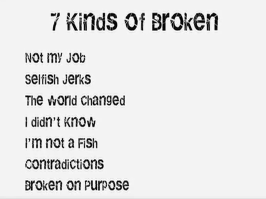
7 kinds of broken designs which Seth mentions......clearly works well with broken payroll processes ( or to define any broken process).
"Not my job" is the best I like..........this kind of broken process creeps into very well designed processes in outsourcing. We create clear process map along with clearly defined roles & responsibility.......which turns out be clear definition of " what I am not supposed to do". This leads to " not my job" syndrome leading well designed process into a broken process.

I am not going to state the obvious ....but this talk is definitely worth listening and one will be able to relate it to lot of experience we face in process re-engineering effort.


Seth Godin at Gel 2006 from Gel Conference on Vimeo.

Tuesday, August 25, 2009

Watch out for chnages in payroll policy landscape in coming years

Dan Pink on what motivates people to perform.

It is very clear what motivates employees in future. Whether it is current complicated structure of incentive or really motivation inducing intrinsic mechanisms.

Current payroll in infected by complicated incentives system . Resulting neither motivating employees nor allowing him to understand how much exactly he should expect in his bank account every month for next 12 months.

Current learning's by company during this recession time will make both employee and employer rethink what they want from their job. In turn changing complex nature of payroll for good........towards simpler zero to gross structure.


Tuesday, July 21, 2009

Customer Satisfaction: Car engine and vanilla Ice cream

This story is very true with Payroll. As much as the problem lay with territorial performances as much as it is with payroll efficiency . But, issues exhibits itself in payroll satisfaction. This becomes evident when we look at payroll process after receiving employee feedback. Look out for detailed root cause for better and sustainable model.My best bet is on asking at least 7 “Why?” to reach the root. remember the payroll rule "payroll is not a process but a symptom". General rule "Devil is in the Details"


A complaint was received by the Pontiac Division of General Motors:
"This is the second time I have written you, and I don't blame you for not answering me, because I kind of sounded crazy, but it is a fact that we have a tradition in our family of ice cream for dessert after dinner each night. But the kind of ice cream varies so, every night, after we've eaten, the whole family votes on which kind of ice cream we should have and I drive down to the store to get it. It's also a fact that I recently purchased a new Pontiac and since then my trips to the store have created a problem. You see, every time I buy vanilla ice cream, when I start back from the store my car won't start. If I get any other kind of ice cream, the car starts just fine. I want you to know I'm serious about this question, no matter how silly it sounds: 'What is there about a Pontiac that makes it not start when I get vanilla ice cream, and easy to start whenever I get any other kind?'"
The Pontiac President was understandably skeptical about the letter, but sent an engineer to check it out anyway. The latter was surprised to be greeted by a successful, obviously well educated man in a fine neighborhood. He had arranged to meet the man just after dinner time, so the two hopped into the car and drove to the ice cream store. It was vanilla ice cream that night and, sure enough, after they came back to the car, it wouldn't start.
The engineer returned for three more nights. The first night, the man got chocolate. The car started. The second night, he got strawberry. The car started. The third night he ordered vanilla. The car failed to start.
Now the engineer, being a logical man, refused to believe that this man's car was allergic to vanilla ice cream. He arranged, therefore, to continue his visits for as long as it took to solve the problem. And toward this end he began to take notes: he jotted down all sorts of data, time of day, type of gas used, time to drive back and forth, etc.
In a short time, he had a clue: the man took less time to buy vanilla than any other flavor. Why? The answer was in the layout of the store.
Vanilla, being the most popular flavor, was in a separate case at the front of the store for quick pickup. All the other flavors were kept in the back of the store at a different counter where it took considerably longer to find the flavor and get checked out.
Now the question for the engineer was why the car wouldn't start when it took less time. Once time became the problem -- not the vanilla ice cream -- the engineer quickly came up with the answer: vapor lock. It was happening every night, but the extra time taken to get the other flavors allowed the engine to cool down sufficiently to start. When the man got vanilla, the engine was still too hot for the vapor lock to dissipate.

Tuesday, July 14, 2009

Thank you!

Thanks you utilizing my blog and providing your feedback /inputs. It has been great journey. I am sure we will go long further from this point.

235 visits came from 23 countries (India, Singapore, United States, Brazil, United Kingdom, China, Japan
, United Arab Emirates, Netherlands & Germany) with 121 visitors from the day it started on 23rd February 2009.

Monday, July 13, 2009

20 minutes to meeting success!


During my past years of experience in meeting I have realized, any meeting will show its color within 20 minutes of its start. In other words after 1st 20 minutes you will know what you will end up by end of the meeting. In very effective meeting you will get the results, go-no go or bring people to common understanding or get agreement on agenda or what ever the result you expect, within 20 min.

Why this has to be 20 minutes I don’t know. I found no scientific answer to this question. Other than the below one …J

"Calendars are based on the earth’s motions: around its own axis, and around the sun in its orbit. But the axis has a slight wobble. In relation to the stars, the earth takes 365 days, six hours, nine minutes and 10 seconds to complete one revolution. This is the sidereal year. With respect to its orbit, the earth takes 365 days, five hours, 48 minutes and 46 seconds to complete one tropical year. This difference of 20 minutes and 24 seconds every year is caused by the earth’s wobble."

When I say you will get the result in 20 min…it is for sure not by magic but with lot of effort and preparedness:

1. Preparing sufficient research on the subject.
2. Ensuring you connect the participants to keep them ready for the meeting. No shockers thrown at them during the meeting.
3. Clear understanding of where we can hit the road block and what are win-win options.
4. Giving enough opportunity of the participants as well to do the above the 3.

Let me know if you have anything else as your learning.

Friday, May 22, 2009

Automation of variable payroll data logistics

One of the main issues in Payroll optimization is Variable Data, which doesn’t flow through the HR data base. This end up in …..Data flowing through multiple modes from multiple people in multiple formats.

Need of automation of data over and above HR data base may be due to:
1. Non localization of the HR databse
2. Payroll required data is not part of HR data base
3. Data originating from business
4. Time data

Some of simplest data automation I can see is using shared server folder which act as junction to combine data automatically. This will be a most cost effective solution especially with technologies like SharePoint.

Usage of much advanced web interface to source data originator along with interface with HR data base can be much more efficient but can be expensive.

Real payroll optimization is not complete without automating variable data logistic to the source of the data. Sometime there can be temptation to semi automate by pushing for unsustainable standardization with just complex data format set or cross subsidizing the effort of pulling the data by payroll team themselves.

Saturday, May 2, 2009

Requirement gathering – Red zone area


Requirement gathering is one of most challenging and complicated part of any payroll project or Process improvement initiative.
The challenge stems from multiple perspectives:
1. Pre conceived notion of the process being complex.
2. Notional statutory ghosts.
3. Miscommunication of requirement.
4. Cultural issues in understanding & agreeing.
5. Confusion between understanding the requirement and agreeing to requirement.Misunderstanding the “I understand” with “I agree” or “I agree” with “I sign off” will lead to disastrous issues at very critical points in the project.

Tools to mitigate red zone:
1. Cultural diversities play a very important part in understanding this red zone.
2. Presence o functional knowledge
3. “Equidistance player” during requirement gathering.

Tuesday, April 7, 2009

Payroll workload & work ethics during recession policy executions


Recession and its impact of business bottom line will lead companies to make changes in its operating cost. Payroll cost will be the obvious the target for different business reasons.
This focus on payroll cost brings lot more stress on payroll work. In this situation it is very important to maintain few fundamental principals of payroll:
1. Never dilute the ownership on the input which will stay always outside payroll. This will ensures there is optimal level of ownership on movement of data and related employee experience.
2. Look very carefully at any new changes you plan to make into payroll process or payroll system with very legal perspective. I am not referring to statutory deduction or calculation. I am referring to how well these changes reflect in your lawyers fact file if an employee files a case in labor court.
a. Avoid out of pay slip calculation which will end up as single amount in pay slip.
b. Avoid short cuts in executing recession driven comp and Benefit policies.
c. Payroll is not a statutory expert ….contact your legal department on final decision.
d. Execution approach which works in one country may not work in another from future legal risk mitigation perspective. Be very mindful of this.
3. Crete at least 2 layers of checks and balance while processing these cases to avoid any over payment or underpayment. Both can lead to very bad press and or attention from regulatory bodies.
4. Never attempt any sort of short cut in calculation, execution or communication.

Good Cultures & bad attitudes


One common rather very common topic in payroll is “cultural issues”.
I hate this negative term which puts a beautiful thing called culture in a negative shade. I am very much for discussion on cultural differences…..it make sense and it is real. But no culture can be an issue. Cultures are beautiful, they have history, they are embedded in every festival of the country, they have parental value, they are spiritual, and they are more long term…..
But what we get hear is 3 folded:
1. Personal attitude issue, we get carried away those few people we meet during our project or work.
2. If Culture X is issue to Culture Y …than Culture Y is also an issue to Culture X.
3. Cultural requirements and professional requirements. Concerned stake holder never attempt to differentiate these 2 especially in a environment like payroll which encompasses personal .

Sunday, April 5, 2009

ROI?

ROI (Return on Investment) at country level or ROI at Global level or ROI at regional level………..which is the right parameter to look at executing business excellence driven transformation projects in HR and Finance process in a multinational?

Thursday, March 19, 2009

Why payroll has to be 100% accurate….what happens if it is only 95% accurate or just 90% accurate? What is the cost of accuracy?


What happens if we deliver only 95% payroll. Can’t we save enough money and enough resources? We know at least 20% to 40% of the payroll time is spent on final product checking to find those possible 2% to 5% error which could have hit the employee.

If the companies compensation policy, countries legal structure and bargain agreement, Employee morale maturity and job market conditions allow....can we capitalize this saving.

I mentioned in my earlier post payroll is not a primary process rather symptom. By extending the same rule, I am pushing us to think in terms of how we can save this cross subsidizing effort.

Premises in this proposal are very robust payroll system and defined data flow logistics.

Let us think one more time…why do we audit payroll and what happens if we don’t….what is the cost of attempt to create accuracy at payroll level.

What is the cost of payroll accuracy? What will be the cost of pay slip at accuracy rate of 99%, what it is at 98%, and what it is at 97%...what it is at 95% or at 90%.............

Tuesday, March 17, 2009

I am a Manager today and how can I become leader in next 1 year time


I am currently a manager and I want to become leader…..what are the competencies I need to work towards to make this happen in next 1 year time?”.
One of my mentee asked me this question “I am currently a manager and I want to become leader…..what are the competencies I need to work towards to make this happen in next 1 year time?”.

Though I answered him by referring and explaining him about how to push himself to his level of incompetency and be proactively think of situation which he need to handle in next 6 months etc.........but I wanted to know more about this question so went ahead and asked a group of leaders across the globe to help me to provide me answer on What will be their advice which I can carry to him .

Each advice below is from different perspective but meeting at common goal. I believe it is very very precious advices if we can digest 40% of this and practice without doubt we can lead ourselves to be leaders.

Daniel Schneider Cultural Architect
The answers I got are very eye opening. Remember these are from group with really high experience leadership techniques ,tools & practice:
the competencies are not necessarily exclusive; so it is possible and desirable to be both leader and manager. In fact, you may already have the competencies. Leaders tend to have a broad level of objectivity and the humility that generally comes with it. They also have an ability to persuade (sell) rather than inform (tell). The three competencies most directly related to successfully leading people and gaining commitment rather than compliance/resistance are persuasive sharing of information, interpersonal skills, and a threshold level of expertise.

Kenneth G. Lassiter Executive Search Consultant
Ask your mentee does he/she understand the big picture. How does his job performance affect the overall mission of the organization he represents? Then ask how does he/she think he/she can influence the direction or the outcomes of the over all mission. The answer will help you understand how they see themselves in their current role. Hence helping to identify the areas were development is needed.

Brian Grayless -Information Technology and Services Consultant and Professional
A HUGE mistake that many people make is that they assume that authority and leadership are the same thing. They are not. Managers are responsible for processes and efficiency. While leaders are responsible for direction, innovation and morale. Many of the required skills may overlap, but how they affect your role can be very different.
If you are already an experienced business person, I would recommend a few books that can greatly change your perspective and move you in the right direction.
1) Principle-centered Leadership, by Stephen R. Covey 2) The 21 Irrefutable Laws of Leadership, by John C. Maxwell 3) How to Master the Art of Selling Anything, Tom Hopkins
Many people wonder why I recommend #3. Well, #1 and #2 will give you the edge up on being a leader and help you understand what that means. However, as a leader, you need to also be persuasive and develop the personality to lead people without them knowing they are being led. You want them to follow and believe in your leadership. As a leader, you are constantly selling something: ideas, yourself, belief systems, potential, etc... You can become a nice, well-meaning leader. But if you can sell your perspective, you will struggle.
And, for good measure, if you haven't already read it, pick up "The 7 Habits of Highly Effective People" (Stephen R. Covey) and "How to Win Friends and Influence People" (Dale Carnegie).
Being a leader is something that is developed, although it can come more naturally for some. If you read, internalize and become the example of the material in these books.... you will be a great leader.

Mario Luis Tavares Ferreira -Owner, International Business Development
What I would like to suggest:
A common sentence that we hear often is that leadership is given not taken, is it true?
Another common sentence is that you are born a leader, that it is a natural gift.
In some aspects it is. But, there are some attitudes that can be taken to change that perception.
A born leader – or so called – is an individual with charisma. He has a natural empathy with people, that has an easily and friendly manner to talk and convince people to do what he wants. He has a global vision of situations and quick answers to the problems, he keeps himself cool when the world exploding around him. He remembers names and profiles of anyone around him. He is a multi-task professional. He can control different areas of business and even different businesses. He is a natural negotiator, internally and externally, on business environment. He manage people naturally without imposing positions. He evaluates, knows how to chose and attracts the best professionals to work with him. He is a visionary. He is a reference to the novice and also to the professional savvy, and so on.
Wow! It seems an endless list to accomplish!
Actually, those skills can and should be achieved by anyone that aims to have a senior position, to manage any organization, team or group.
First of all, you should make a self-evaluation to define if you want or not to be a leader, to have more responsibilities and to dedicate energy to achieve that goal. It is not an easy path, often shifting from success to failure and from failure to success very quickly, need to be stress resistant and many times it is a lonely path.
Be careful with suggestions like “10 steps to become a leader”, there is no magic, or recipe or formula to transform you into a leader. To be recognized as one it takes a long path and a natural evolution. As said in the beginning, leadership is given not taken.
But you can prepare your self to be ready, when comes the opportunity, to assume the responsibility.
Bellow you can find some suggestions to prepare your journey.
To continue reading:
http://marioferreira.wordpress.com/2009/02/18/to-lead-or-not-to-lead/

Darryl Barlett, SSMBB, CMC, CPA, PMP -Senior-Level Business and Information Technology Consultant
Specifically, here are the competencies you need:
Integrity and Honesty Technical Proficiency and Expertise Ability to solving problems and analyzing Issues Be Innovative (Adapting to Change) Practice Self Development Drive for Results Establish Personal Stretch Goals Take Initiative Communicate Powerfully Inspire and Motivate others Build Relationships Develop Others Foster Collaboration and Teamwork Develop a Strategic Perspective Champion Change Connect with the Outside World Be Customer Focused
This may not all happen in a year,

Koshy Philip - Human Resource Manager
There is a distinction between becoming a leader and BEING a Leader.
The normal way that people think is that you have to DO something : to HAVE something to BE a Leader.
However I recommend that you advice your mentee to first
BE------- a leader then DO--------- What ever needs to be done To HAVE -----------the competencies
To your and the mentee surprise , it may not even take 1 year.

If the whole world followed you, would you be pleased with where you took it?

Sally Graham - Sr. Mngr, Ecommerce OfficeMax

http://tppserver.mit.edu/esd801/readings/managers.pdf
Great reading the difference in leaders and managers..
Let me know your thoughts. I found this article by MIT very insightful..

Gardner Bradlee - Global Marketing Professional
Take these to heart. Sometimes the simplest things are the most effective. However they take practice and don;t come naturally to many people:
http://www.businessweek.com/smallbiz/content/oct2007/sb20071010_093227.htm

Soowan Scheuermann -Area Manager at Aquent
I think the first step is to understand why your mentee is bringing this question up. Do they have the feeling that they have a title with authority but no influence? My personal thought is that the key to leadership is "lead". You can not influence people in places and directions you have not been yourself. Whether it is character, work ethic, integrity, results, development etc., it is extremely difficult to lead where you have not been.
I would recommend the books "Becoming a Person of Influence" and "Winning with People" both by John C. Maxwell. Another good book is "Centurion Principles" by Jeff O'Leary
Once you identify your mentee's sphere of influence, then you can work on expanding that sphere through small tasks, projects, or measurable goals that they have to accomplish through others that report to them. Make sure that they need to accomplish them through others. Gradually, those projects will help your mentee understand how to lead through influence and motivation rather than manage through title and authority. The greater a person's influence, the greater their leadership.
Then... getting them to understand the balance of management and leadership will create an incredible asset.

Carry Metkowski -Director of Program Development at The Producers LLC

A quote I live with is, we are drawn to what is already in us. The fact that you are drawn to leading is clue that you are ready to begin the process of more fully expressing yourself in the organization.
If it were me, I would go three places for feedback. One- my current leader. Ask him/her for their view of your strengths and opportunities. Also, share where you grow into the organization and ask for specific help.
Two- Ask those you currently manage for anonymous feedback. Then create a plan to address the feedback with your leader and implement the plan for at-least 6 months, checking in with those it impacts monthly and re-evaluate with a follow-up feedback questionnaire to measure your success.
Three- The closest personal relationship in your life. Lets' face it, if you can't make it work at home, you can't really make it work anywhere. And to be honest this is where I get me best feedback.

Renato Reis - Sr. Systems Analyst - Operation Applications at The MathWorks
Do you lead in any other situation other than @ work?
Do you think you would follow someone like you? why?
When you are playing team sports, do you think your team mates know in the first 5 minutes of the game that you can be followed?
Walk the talk...

Cathy Hansell - President, Breakthrough Results, LLC

What a wonderful question, and a lifetime to answer. In my own experience, as well as learning from excellent mentors, good leadership comes from within yourself...a sincere, passionate drive for the betterment of the work and people around you. Everyone, in any role and at any level, can be a great leader.
I recommend that you first assess and understand your own personal drivers and desires, by reading books like "The Power of Positive Thinking" by Norman Vincent Peale and "Purpose Driven Life" by Warren, "Radical Leap" by Steven Farber and 7 Habits by Covey (referenced above).
Then learn from the best leaders...Jack Welch (29 Leadership Secrets), Larry Bossidy and Ram Charan (Execution-the Discipline of Getting Things Done),Henry Cloud (9 Things A Leader Must Do) and John Collins (Good to Great). All of these authors are successful, motivating leaders and drivers of great change. Also, talk with leaders and people that you admire.
You will quickly see common key actions. One of the greatest leaders that I have even known,and have been priviledged to work for was named Fred. He was the brightest and kindest man, and appropriately termed a "people person". With his great intellect and kindness, he motivated and led large organizations to follow him.

Jim Sparks -Alternative Investment Advisor at Western Financial Planning Corporation

Here is the answer you are looking for: You are already a leader, otherwise you would not be a manager. To become a manager you need to exibit the qualities of a leader. For example you are probably a pace setter...you arrive early and stay late. You are available when your team members need your help (whether they asked for it or not). You want to know how your team will benefit, not how you will benefit. You are not opposed to hiring and promoting those who know more than you do and you are always looking for your replacement for when you move up. You are undoubtedly aware of a few adages such as "Givers Gain" from Dr. Ivan Misner, "Success might be possible if you don't try to achieve it all by youself" from Rev Robert Schuller. and "If you want to be trusted, be trustworthy. If you demand hard work, work hard. If you want your colleagues to level with you, level with them..." from founder and former CEO of the Vanguard Mutual Fund Group and authur of Enough, True Measures of Money, Business and Life. Also: "Never, Never, Never, Never Give up!" Sir Winston Churchill. Above all: "Leaders are readers and readers are Leaders" Jim Rohn. Hang in there.

Travis Keenum - Experienced Human Resources Professional

It's really not as difficult as some might think. Tell your mentee to focus first on being a teacher. If he will work hard at this for a year he will develop all of the other characteristics it takes to become a leader.

if a manager wants to be a leader he should focus first on being a teacher. If the mentee will expend the energy and take the time to teach his or her subordinates, he or she will develop the skills that are necessary to be a leader.

krishna koney -Senior Software Consultant at Intel

1. Lead by example ; Set yourself as a Role Model to the team
2. Innovate
3. Mentor

Linda Garza Kalaf, SPHR, GPHR, MA -Manager, HR at Veolia Transportation

According to the Society for Human Resource Management, the competencies you need to become a global leader include:
1. Thinking globally
2. Appreciating cultural diversity
3. Developing technical savvy
4. Building partnerships and alliances
5. Sharing leadership

Swamy Swarna - Quality, HRD, Communications, Author, Editor, Reviewer, Holistic and Spiritual Healer

My first reaction was: is a manager not a leader? Then as I was glancing through some of the comments by others (I did not read them so as not to influence my own thinking), my next thought was this: a leader leads you into new territories and so must be daring, innovative and should have a good vision and a goal. So, your manager must learn to do some out-of-box thinking and should have skills in change management, innovation, clear vision and a goal worth looking up to.

W. Haddon Judson - Physicist Engineer, Technical Consultant

Leadership is vision, not management. Management is the ability to execute the vision. Leadership is also the ability to assemble an effective management team. One can have the "Leadership Spark" and start out in management. Then progress to the next level. If the spark is not there, the best you can hope for is to be as effective as possible in your management role. Taking various courses and reading the various papers as suggested above may help you become a more effective manager, but will not help you in any sort of leadership role. Learning the role of a positive and forceful leader is basically "On the Job Training". Reading articles and publications about various business leaders like Trump or Gates only sells books. You will have to go out into the real world and stumble, fall and pick yourself up until you find your own personal style. You have to know your own limitations, your area of expertise.

Chris Klinker
The above is some very sound advise with many common threads.
The one thing I believe I can add, is that in order to lead you must first be respected. And always, always, always remember: ~Respect is not a given right; ~You must earn it each and every day
Take care and never stop learning.

Ravi Kumar Putcha
a set of "essential" qualities to refine his list, and the ones I can think of are:
1. A strong ethical foundation,
2. The ability to know when to switch between "big picture" and details,
3. A clear understanding of own to-dos vs get-dones,
4. The ability to keep the team aware of the overall objectives of a project/organisation, and how the team's work contributes to attaining them,
5. A strong customer/client-centric approach,
6. The awareness of the "marketplace" and how well prepared the organisation is to meet these expectations.
7. Establishing a trust-based relationship with the team he leads.

Mahesh Verma
I would like to add the following 10 qualities that I suppose anyone should have to be a leader - 1. Leader should have the "vision" - he should be able to "see" and "show" where his direction leads to. Leader is expected to be focused.
2. A leader should be a very good communicator. Having vision is not enough, if your team fails to "see" what you "see", they will follow you blindly (because thay have to) and will not be able to understand "why" they are doing "what" they are doing.
3. Leader should add value - to the organization , to the people.
4. Leader should be able to provide solutions.
5. Leader should be a good listener.
6. Leader should be a team player. Leader can get the best from his team only if he does not practice bias in any form.
7. Leader needs to be compassionate but not emotional.
8. As a leader you need to "set" examples for your team and not "give" examples. Team believes and lives by the leader, who they feel, is himself capable of executing what he preaches.
9. Leader should stand for his team and treat the team members with respect. Team that knows that its leader will back them, will not hesitate to take "right" action in the interest of the company.
10. Last but not the least, leader must be able to take responsibility for the performance of his team. If the team does not produce results, it is as much a failure of the leader as it would be of the team / team member.